
Why Customers Buy from Your Competitors: 5 Psychological SEO Tricks for More Sales
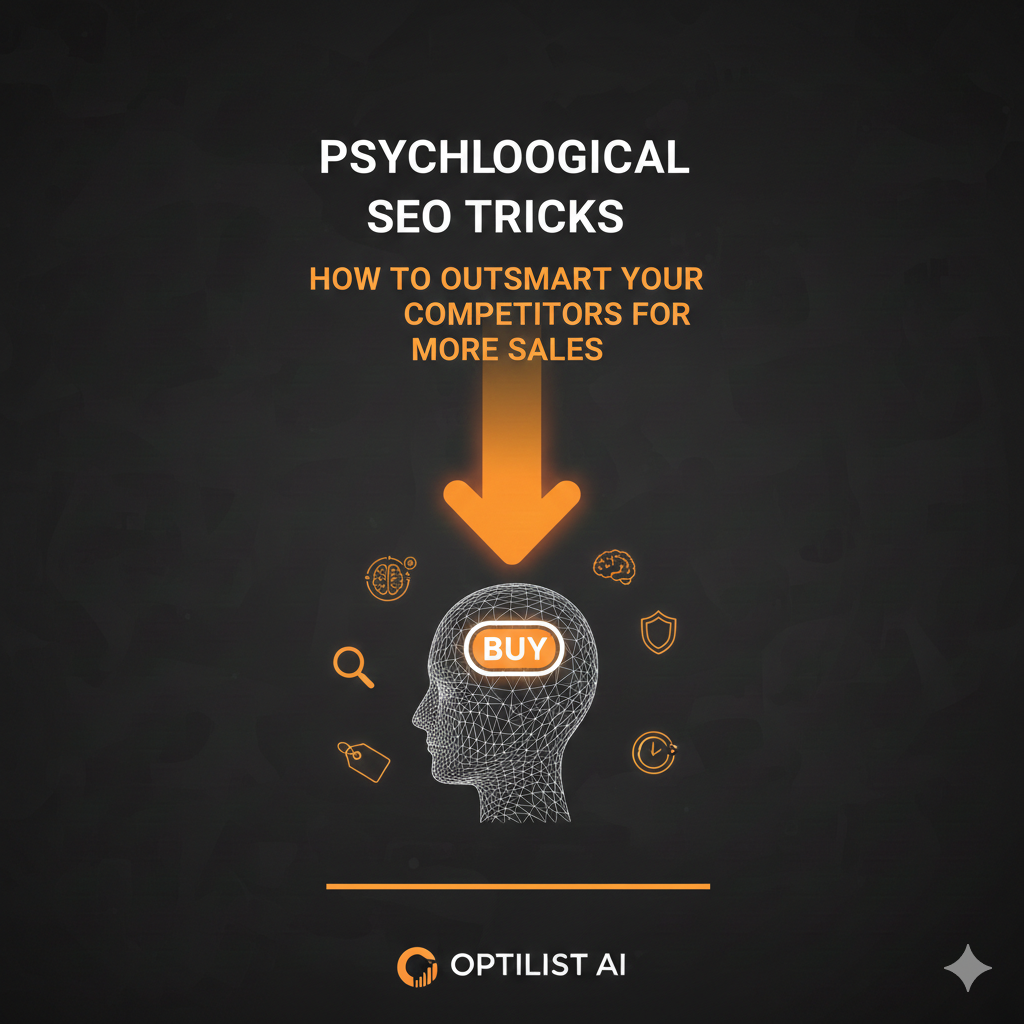
You have the keywords. You have the images. You even have a competitive price. Yet, for some reason, customers keep clicking on your competitor’s listing instead of yours.
In the world of Amazon, eBay, and Etsy, SEO isn't just about satisfying an algorithm; it’s about winning a psychological battle for the customer's attention. If your listing doesn't trigger the right mental shortcuts, you'll always be second best.
Here are 5 psychological SEO tricks to stop the scroll and turn "browsers" into "buyers."
1. The Power of "Micro-Certainty" in Titles
The human brain is hardwired to avoid risk. When a customer scans a search result page, they are looking for the path of least resistance.
- The Psychology: Ambiguity is the enemy of conversion. If your title is vague, the brain ignores it.
- The SEO Trick: Use "Certainty Keywords" in your title. Phrases like "Certified," "Universal Fit," or "Heavy-Duty" provide immediate mental reassurance.
- The Result: Higher Click-Through Rate (CTR) because the customer feels "safe" clicking your link.
2. Using "Anchor Terms" for Value Perception
Price is relative. A $50 product looks expensive next to a $30 one—unless you use your SEO copy to "anchor" a higher value in the customer's mind.
- The Psychology: People don't know what something is worth until you tell them.
- The SEO Trick: In your bullet points, mention the problem cost before the solution price. Use keywords like "Professional-Grade" or "Lasts 5x Longer" to justify your price point.
- The Result: You stop competing on price and start competing on perceived value.
3. The "Scarcity and Freshness" Signal
Marketplace algorithms prioritize "Freshness" (recent updates or sales). Customers prioritize "Availability."
- The Psychology: The fear of missing out (FOMO) is one of the strongest purchase drivers.
- The SEO Trick: Update your backend keywords and listing descriptions to reflect current trends or seasons (e.g., "2026 Edition" or "Limited Spring Batch").
- The Result: The algorithm sees an updated listing, and the customer sees a relevant, limited-time opportunity.
4. Visual Hierarchy and "The Rule of Three"
When customers read on a screen, they don't read every word—they scan in an F-pattern.
- The Psychology: The brain processes groups of three better than any other number.
- The SEO Trick: Structure your most important benefits into three clear, keyword-rich bullet points. Use bold headers like Built to Last, Easy to Install, and Eco-Friendly Materials.
- The Result: The customer absorbs your value proposition in less than 3 seconds.
5. Decoding the "Competitor’s Review Language"
Your best SEO strategy is hidden in your competitor’s one-star reviews.
- The Psychology: Customers buy to solve a specific pain point. If your competitor is failing to solve it, that’s your entry point.
- The SEO Trick: Find what customers complain about in rival listings (e.g., "too small," "hard to assemble") and put the opposite keywords in your title: "Extra-Large Size" or "No Tools Required."
- The Result: You are literally answering the customer's secret prayers before they even ask.
Win the Psychological War with Optilist
Understanding consumer psychology is half the battle. Implementing it across hundreds of listings is where most sellers fail.
Optilist doesn't just look at keywords; it looks at market positioning. Our AI analyzes your competitors' listings to find the psychological gaps you can exploit.
How Optilist gives you the edge:
- Competitive Gap Analysis: We show you which keywords your competitors are using to steal your traffic.
- Conversion-Optimized Copy: Our AI suggests titles and bullets designed to trigger the "Buy" button.
- Instant Audit: See exactly where your listing is failing to build trust with the customer.
Stop being the "alternative" and start being the "choice." [Analyze your listing with Optilist and outsmart your competition today!]
FAQ: Psychological SEO
Does changing my title frequently hurt my SEO?
Micro-adjustments for testing (A/B testing) are healthy. However, avoid changing your core "seed keywords" too often, as the algorithm needs time to associate your product with those terms.
Can SEO really influence "Trust"?
Absolutely. A listing with no typos, professional formatting, and specific technical attributes (Item Specifics) creates "Cognitive Ease." When things are easy to read, the brain automatically perceives them as more trustworthy.
How does Optilist know what my competitors are doing?
Optilist’s AI scans live marketplace data to track shifts in competitor keywords, titles, and ranking positions, giving you a real-time view of the psychological landscape of your niche.